
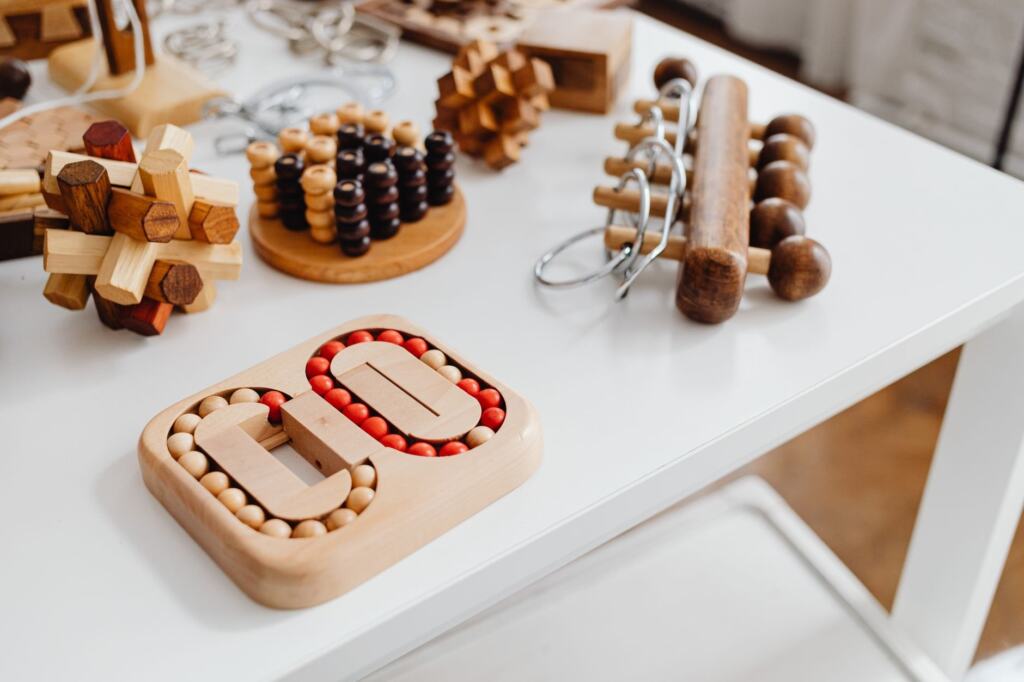
Puzzles that teach design constraints work when a limit, such as a fixed set of parts, a budget or a space, forces a choice. A learner has reasoned about the trade-off when they can say what they gave up, not just show a finished solution.
A common scenario: a learner snaps the last piece in, announces “done”, and nothing shows they weighed anything. The puzzle was solved, but no decision was visible. Changing the limit, or asking the right follow-up, turns that moment into a lesson. This guide sits within the wider set of educational puzzles for kids and focuses on the constraint side of engineering thinking.
How puzzles turn limits into design constraints
A design constraint is a limit that any acceptable solution must respect. A puzzle supplies constraints by fixing what is available and by removing the cues a solver normally leans on. Criteria describe what a good solution must achieve; constraints describe what restricts how it can be reached. Good puzzle activities make both visible.
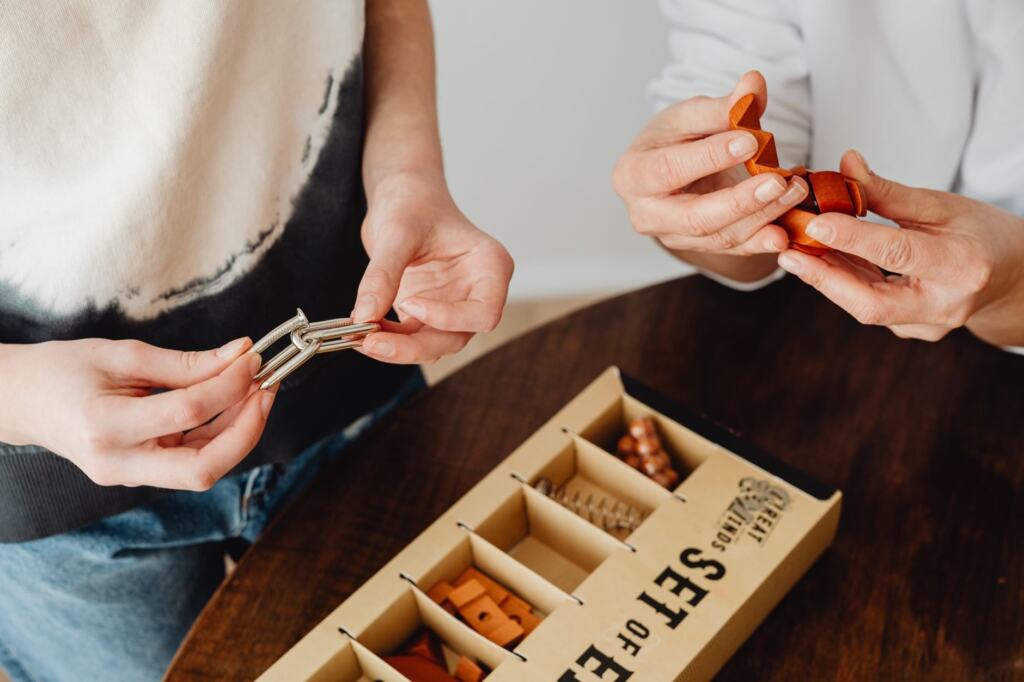
Two cue-removing designs show the idea clearly. According to a puzzle buying guide, irregular pieces add complexity because the solver can no longer rely on finding corners or straight edges. The same guide notes that with clear acrylic pieces there is no colour to rely on, so the usual strategies are useless.
For teaching, the value lies in what happens next. When a familiar cue disappears, the learner must invent another strategy, and the strategy they choose shows how they handle a restriction. That is problem solving under a constraint, not just pattern matching.
Limited parts: when the kit sets the rules
A fixed kit is the simplest constraint to set up. Every piece is already decided, so the learner cannot fix a problem by adding material. They have to rearrange, reorder or rethink what they hold.
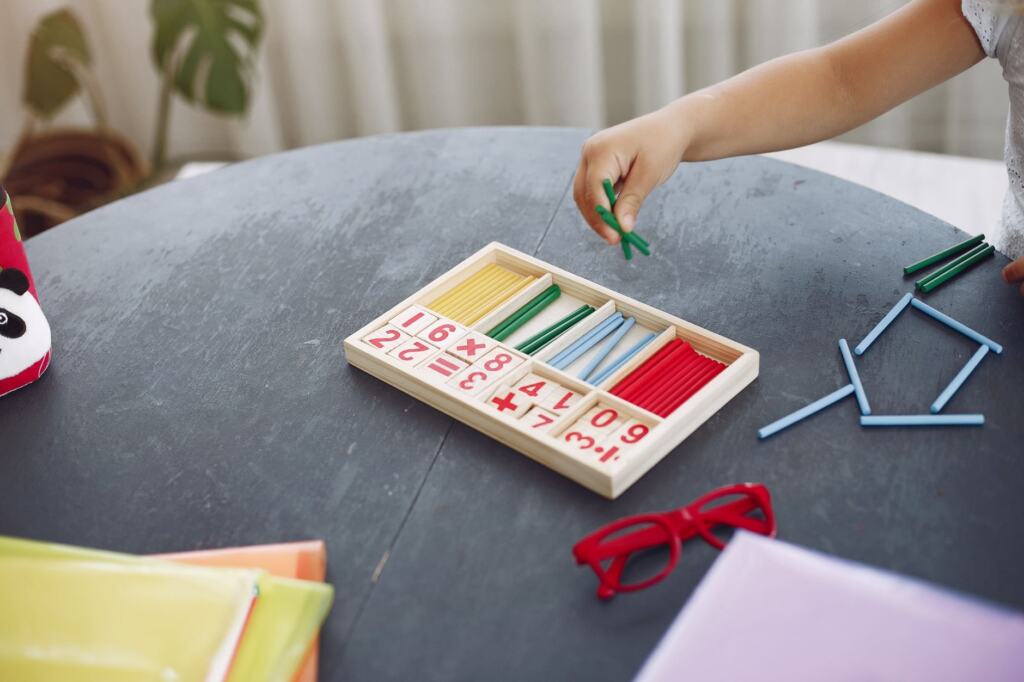
Mechanical puzzles suit this well. The same buying guide describes them as hands-on brain teasers that require you to manipulate physical mechanisms. Because the learner tests ideas on the object itself, each failed attempt works like a test of a rough physical model. That is close to how a prototype is used in engineering: try it, see where it fails, change it.
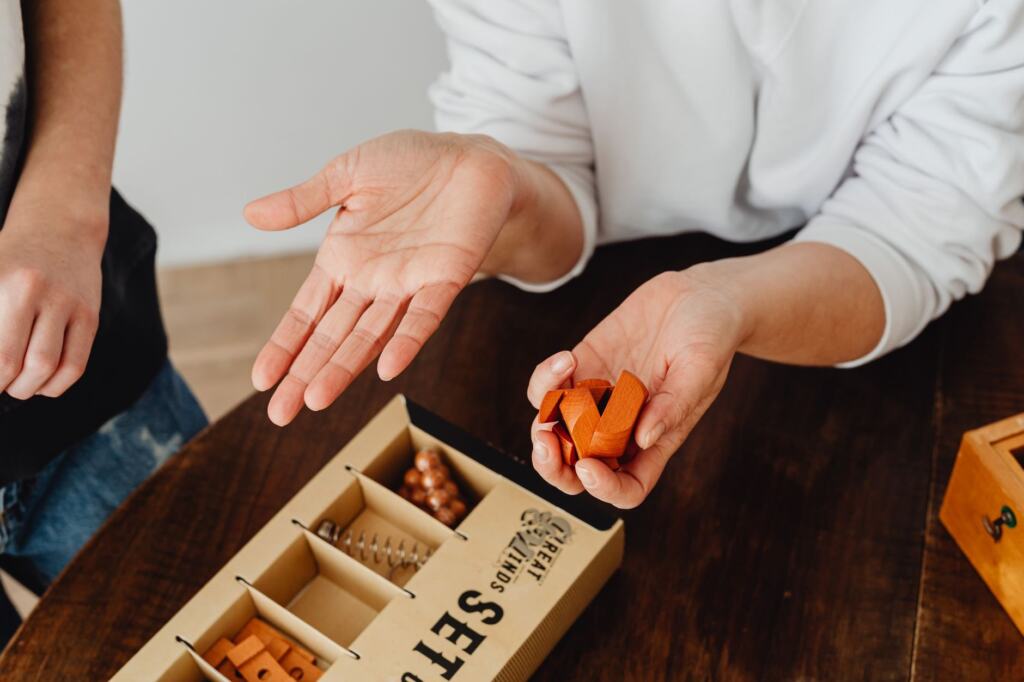
When setting up a limited-parts challenge, print or write the parts list and keep it visible. A visible list makes the limit a shared rule and makes it easier to ask later which parts the learner chose to leave unused.
Budget and material: cost, strength and size
Puzzle materials already contain a cost-versus-durability trade-off. The buying guide says cardboard is budget-friendly while wooden puzzles offer a more premium feel. It also says wooden pieces resist bending and fraying, which makes them suited to repeated use.
That answers which puzzles force a trade-off between cost, strength and size, at least in part. A choice between cardboard and wood puts cost against durability directly. Size is different: a puzzle format rarely forces it on its own, so a space limit has to be added by the activity, such as a footprint the finished build must stay within. Treat the three as separate levers and add the one the puzzle lacks.

For a design-with-a-budget STEM activity, give each part a price and hand out a fixed amount of play money. A learner who cannot afford the stronger part must decide where strength matters most and accept weakness elsewhere. That choice is the trade-off, and it is worth discussing aloud.
Choosing a puzzle by the limit it creates
Different puzzle types create different limits. The table below matches each to the trade-off question it supports, so the puzzle can be picked for the lesson instead of the other way round.
| Puzzle type | Limit it creates | Trade-off question to ask | Planning use |
|---|---|---|---|
| Cardboard versus wooden jigsaw | Material cost against durability | Is repeated use worth a higher price? | Good for a budget lesson with a clear cost choice |
| Irregular-piece jigsaw | No corner or straight-edge cues | Which new strategy replaced the missing cue? | Suits learners who already solve standard puzzles easily |
| Clear acrylic puzzle | No colour to guide matching | What information was left to use instead? | Shows how removing one input changes the whole method |
| Logic puzzle | Rules only, deductive reasoning and no pictures | Which rule ruled out the most options? | Isolates the reasoning from any hands-on building |
| Mechanical puzzle | Fixed physical mechanisms to manipulate | What did each failed attempt reveal? | Works as a hands-on stand-in for testing a prototype |
The material, cue and mechanism details come from the puzzle buying guide cited above; the trade-off questions are teaching suggestions built on them.
Checking that the learner reasoned about the trade-off
A correct answer proves little, because a learner can reach it by luck or by copying. Reasoning shows up in the explanation. Ask for it right after the solution, while the attempt is still fresh.
- Name the limit. Ask the learner to state the constraint in their own words, such as the parts available, the budget or the space.
- Name the rejected option. Ask what else they considered and what it would have cost them in strength, price or room.
- Change the limit. Ask what they would do differently if the limit were looser or tighter. A learner who reasoned can answer this; a learner who guessed usually cannot.
- Compare with a peer. Have two learners work from the same limit and set their solutions side by side, then explain why they differ.
The comparison step is the most revealing. When both learners had identical limits but ended up with different designs, each must justify what they prioritised. That conversation, more than the finished object, is the evidence of a trade-off being understood.
Troubleshooting common problems
- The learner guesses instead of reasoning. Add a short record step: write down each attempt and why it failed before the next try. Mechanical puzzles reward this because every failed manipulation gives information.
- The challenge is too hard. Piece count is a quick difficulty gauge in the buying guide, which says fewer than 300 pieces suit beginners. Start there before adding other limits, so the learner meets one new restriction at a time.
- The challenge is too easy. The same guide calls a 500-piece puzzle a solid intermediate challenge. A higher count helps, but removing a cue, such as straight edges or colour, adds difficulty in a different way.
- The learner stops at the first solution. Ask for a second design under the same limit. Seeing two workable answers is what makes a trade-off visible.
- The limit feels arbitrary. Tie it to a reason, such as a fixed budget or a parts list, so the learner treats it as part of the problem and not as an obstacle set by the adult. The right level also depends on the learner, so engineering puzzles by age is a useful next read when choosing difficulty.
Starting small with everyday parts
A purchased puzzle is not required. A small fixed set of familiar objects, such as counting sticks, blocks or paper sheets, can carry the same lesson if the rule is clear: build the strongest or tallest thing you can, using only these parts.
Keep the first round open and unscored, then add a price to each part in the second round. The change from free choice to a priced set shows the learner how a budget reshapes the same task. Once the limit idea is familiar, cause and effect puzzles for learning engineering build the next skill: tracing why a change in the design produced a change in the result.
Frequently asked questions
| Question | Answer |
|---|---|
| Does a higher piece count always mean a harder limit? | No. The buying guide points out that a 500-piece puzzle of a clear blue sky can be harder than a 1000-piece cityscape, so image complexity can outweigh the count. |
| Do wooden puzzles teach more than cardboard ones? | Not necessarily. They teach a different trade-off. Wood costs more but resists bending and fraying, while cardboard is the budget-friendly choice, so each suits a different lesson about cost and durability. |
| Can a puzzle with no pictures still teach constraints? | Yes. Logic puzzles rely on deductive reasoning without pictures, so the rules themselves are the constraints. They suit learners who need to practise reasoning without any building. |
| Why use a mechanical puzzle for a prototype-style lesson? | Mechanical puzzles require handling physical mechanisms, so the learner tests and revises ideas on a real object. That repeated try-and-adjust cycle resembles how a prototype is improved. |