
| Reader situation | Activity or puzzle type | What to observe | Planning use |
|---|---|---|---|
| Teacher needs a quick whole-class demonstration | Toy car on a tilted track | How far and how fast the car travels when the surface or tilt changes | Fast to set up, and shows motion before any equations appear |
| Teacher wants to compare materials | Blocks faced with sandpaper, felt and plastic | Which block moves first and which needs the biggest pull | Makes surface differences visible; suits a small-group rotation |
| Students ready to measure | Spring scale pulling a block along a board | The scale reading at the moment the block starts to move | Turns friction into a recorded pull that can be compared |
| Learner playing on a screen | Digital puzzle with a ball sliding on a slope | Predicted path against the actual path after one change | Cheap repetition; best paired with a physical test afterwards |
| Class linking play to Newton’s laws | Force, mass and acceleration record sheet | Whether the motion matches the forces drawn | Gives each puzzle a written prediction and a written result |
Definitions of force, net force and balanced forces follow the Legends of Learning forces and motion curriculum, while the force-and-acceleration measuring idea comes from the LibreTexts Newton’s Laws exercises.
Puzzle games that teach friction work best when each level is treated as a small experiment: predict the motion, change one surface or slope, then compare what actually happened.
Families and teachers building a wider shelf can start with the hub of educational puzzles for kids, then return here for the force-and-motion side.
For a quick whole-class demonstration
A demonstration needs to run in a few minutes with materials already in the room. The two setups below suit that situation, because each changes only one thing between runs.
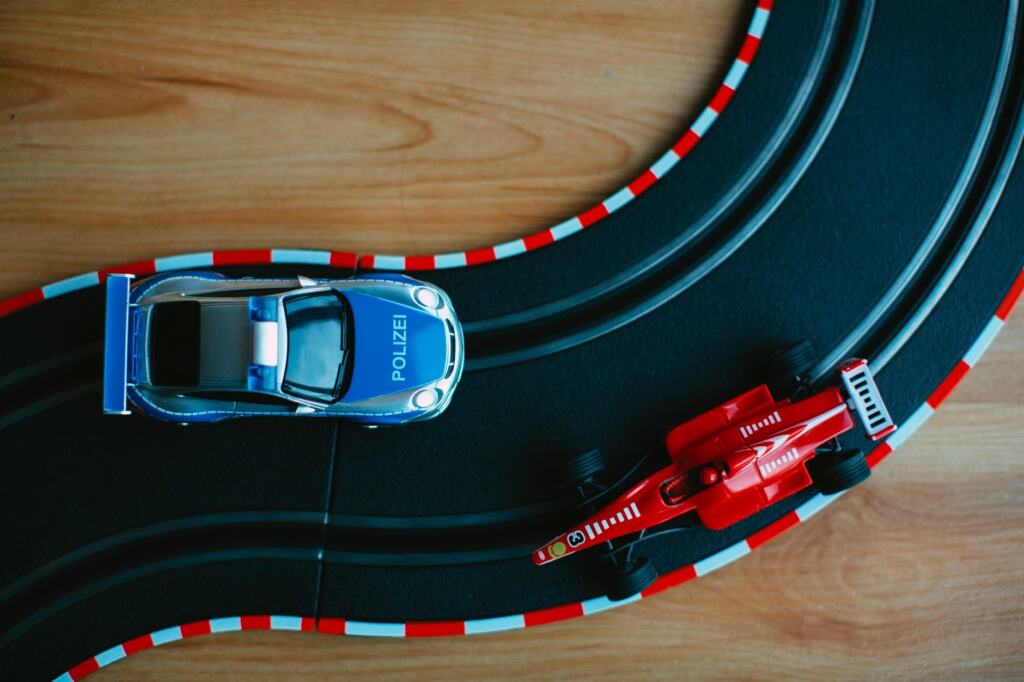
Toy car on a tilted track
Raise one end of a track or board and release a toy car from the same mark every time. The setup is an inclined plane puzzle in physical form: the tilt is the only thing the class adjusts, and the car’s motion is the answer.
This suits younger students and mixed-ability groups, because the question is simply what the car does. Ask students to predict the outcome before each release. The limitation is precision: judging by eye shows trends but does not give a force, so use it to start the discussion and leave measurement to the later setups.
Surface-swap blocks
Cover identical blocks with different materials, such as sandpaper, felt and plastic, and line them up at the top of the same ramp. Students predict the order in which the blocks will move, then check. Keeping the blocks identical in size and weight matters, because otherwise the surface is not the only change.
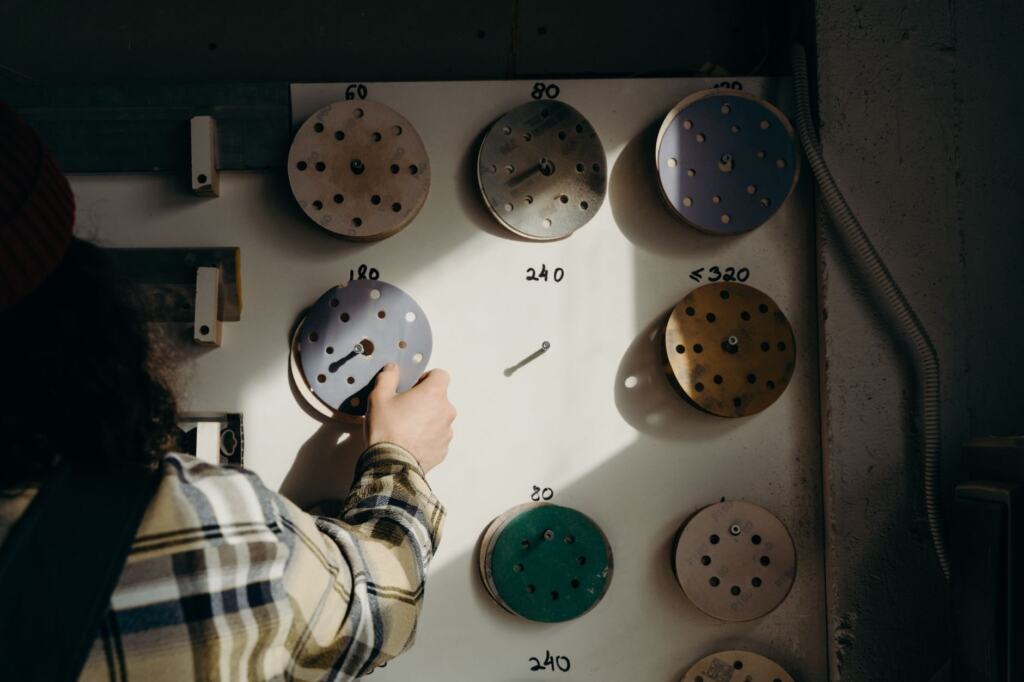
This works as a group rotation and gives a clear reason to talk about fair testing. It is less useful for a whole class watching one demonstration, because the differences can be small to see from the back of a room.
For students who need to measure
Once students can describe what happens, the next step is to put a number or a recorded observation beside each run. The methods here keep the equipment simple and the records comparable.

Spring scale on a block
A force is a push or a pull on an object, according to the Legends of Learning curriculum. A spring scale makes that pull readable. Hook the scale to a block, pull slowly along a board, and note the reading as the block starts to move. Repeat on each surface and on a raised board.
This suits students who are ready to record data. Pull steadily, since a jerky pull makes readings hard to repeat. Several attempts per surface give a more trustworthy picture than a single one.
Force, mass and acceleration data
The Gettysburg College physics text on Newton’s laws exercises pairs a known net force with a measured acceleration. One exercise has a cleaner pushing a 4.50 kg laundry cart so that the net external force is 60.0 N. Another gives a 63.0 kg sprinter starting a race with an acceleration of 4.200 m/s².
Those exercises are a model for the columns on a class record sheet: mass, net force and acceleration for each run. Students can then ask whether a heavier block or a stronger pull changes the motion more. Treat the textbook values as examples of the format, not as targets for a classroom ramp.
The record sheet
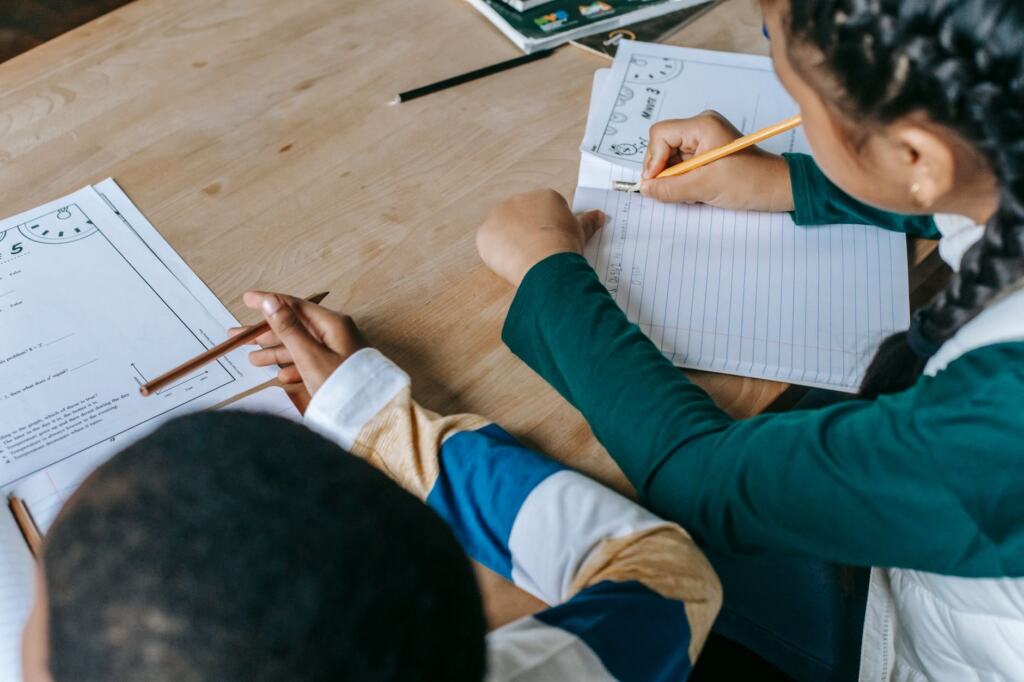
Give every group the same sheet, with space for a prediction, the surface used and the observed result. Comparable sheets let the class pool results and spot a run that does not fit.
For learners playing on a screen
Digital physics puzzles offer fast repetition that a ramp and a set of blocks cannot match. They teach most when the player has to reason about the forces rather than tap until a level clears.
How puzzle games teach friction
In a ball-on-slope puzzle, the player changes a surface, a slope or a starting position and watches the result. That loop of prediction, change and observation is what makes the game a test of motion. Gravity is the force that pulls objects on Earth down toward the surface, and on a slope the player sees what that pull does when something else resists the slide.
The textbook treatment supports this framing, since friction appears as its own section (2.05) inside the Newton’s Laws chapter of the same LibreTexts course. Friction is handled alongside the other forces on an object, so a puzzle that makes a player weigh it against gravity is working on real course material.
Judging a physics puzzle for class use
A good candidate lets the player change one thing at a time and shows the outcome clearly. Weigh these points before assigning one:
- Single-variable changes. If a level alters several things at once, students cannot say which change caused the result.
- Room for a prediction. Choose puzzles where the player can state an expected outcome first. A game that rewards trial and error teaches less.
- A follow-up on paper or a ramp. Ask students to reproduce one level with real blocks. The screen is a supplement, not a replacement for a physical test.
Games are a weaker choice when a class has no time to discuss results afterwards. Without that discussion the physics tends to stay inside the game.
For linking play to Newton’s laws
Games and ramps become more useful when students can name the forces involved. Three short ideas cover most of the connections.
Balanced and unbalanced forces
The net force is the sum of all the forces acting on an object, and when it is zero the forces are balanced, as the Legends of Learning curriculum explains. On a ramp, ask students to sketch the forces on a block that is not moving, then on one that is. The drawing shows whether the forces cancel.
Gravity on the slope
Because gravity pulls objects down toward the surface, a block on a board is always being pulled. Tilting the board changes how that pull shows up in the motion. Ask students to describe the tilt they used and what the block did, rather than only whether it slid.
Action and reaction
Not every force-and-motion puzzle involves a ramp. The LibreTexts exercises ask why an ordinary rifle recoils, kicking backward when fired, as a question about Newton’s third law. A balloon-powered car or a pushed skateboard brings the same idea into a classroom. Students who enjoy this angle may also like the balance puzzles that teach center of mass, which build on the same habit of drawing forces before predicting.
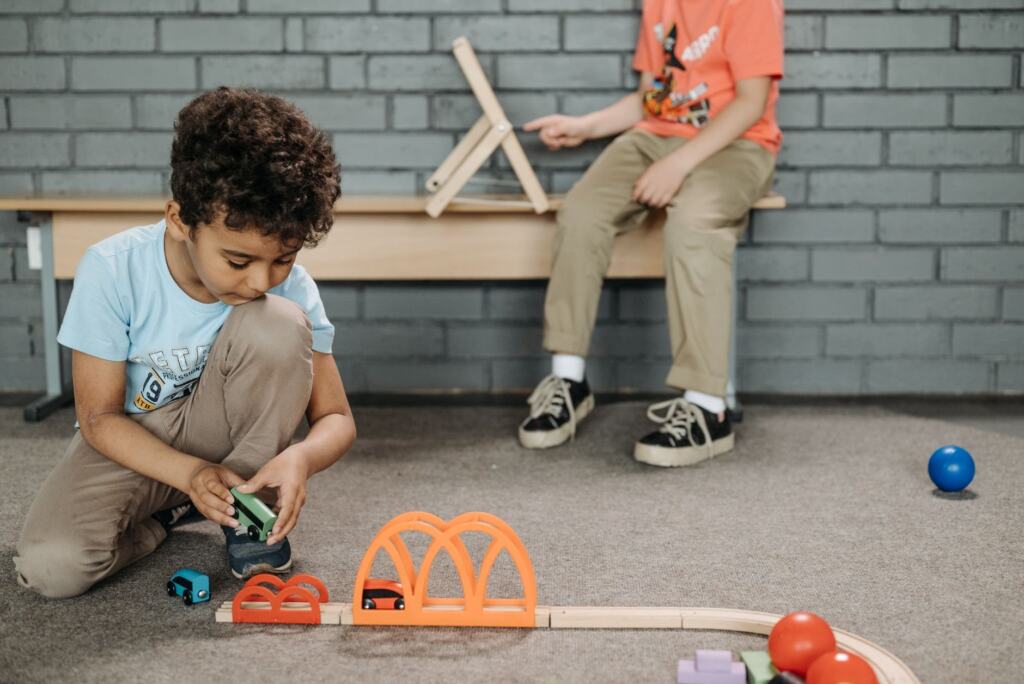
Ramp tests also train a skill beyond physics. Students must picture the board, the block and the direction of each push or pull before they test anything, which is the reason many educators ask why is spatial reasoning important for engineering and answer with activities like these.
Frequently asked questions
| Question | Answer |
|---|---|
| What counts as a force in these activities? | Any push or pull on an object, including a hand pulling a spring scale and gravity drawing a block toward Earth’s surface. |
| Where does a physics textbook place friction? | The Gettysburg College course on LibreTexts gives friction its own section, 2.05, inside the Newton’s Laws chapter. |
| How can mass be found from a known force? | Apply a known force and measure the acceleration it produces. The textbook example does this for an astronaut, with a net force of 50.0 N producing an acceleration of 0.893 m/s². |
| Can a game replace a hands-on ramp test? | It is better used as a companion. The game gives quick repetition, and a physical test lets students feel and measure the same effect. |